
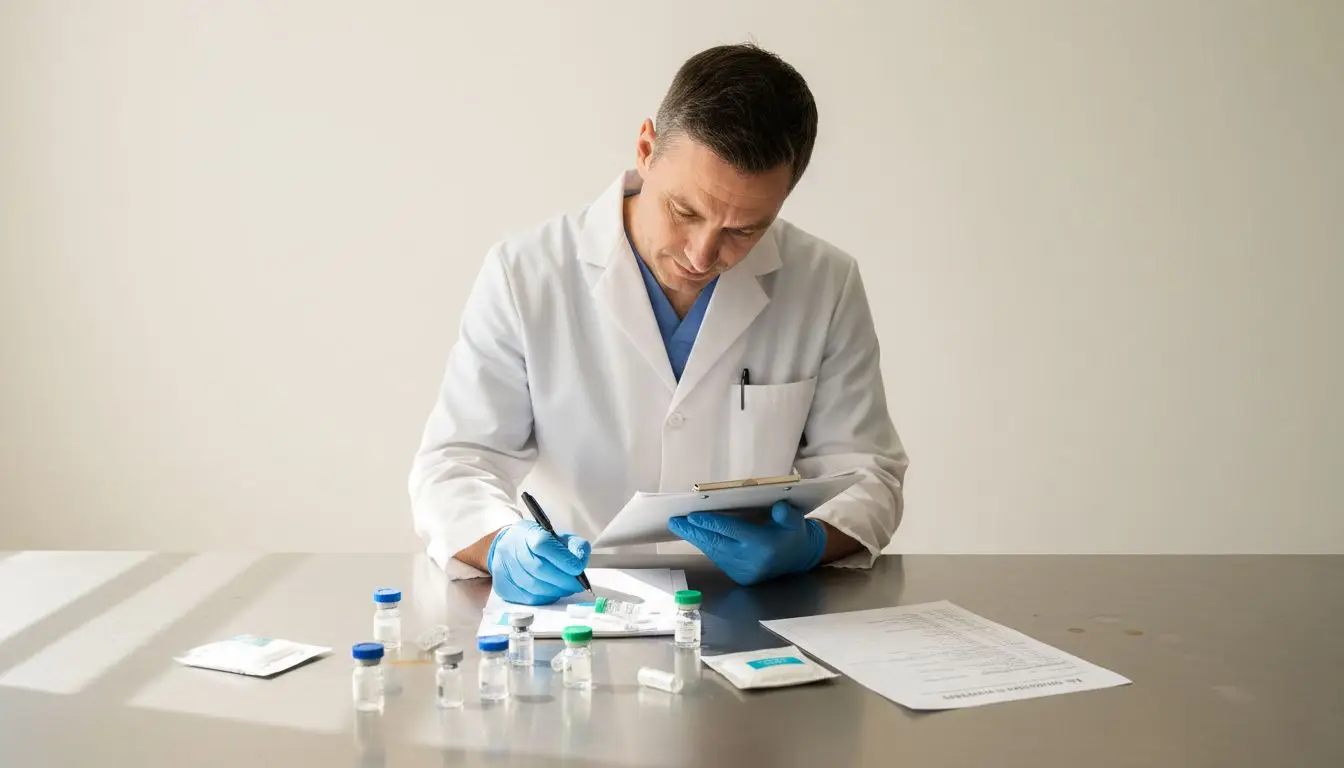
Every Texas researcher knows the smallest details can make or break a peptide experiment. When precision matters, starting with the right lab materials is essential for reliable reconstitution and consistent results. Using sterile technique and comprehensive equipment checklists not only protects your samples but also helps avoid the frustration of contamination or dosing errors. This guide breaks down what you need to create a controlled environment and highlights proven steps for safe, accurate peptide handling so your research moves forward smoothly.
Table of Contents
- Step 1: Gather Essential Lab Materials And Supplies
- Step 2: Sanitize Workspace And Prepare Research Vials
- Step 3: Add Solvent To Peptide Vial For Dissolution
- Step 4: Mix Peptides Gently For Perfect Clarity
- Step 5: Verify Purity And Stability Of Reconstituted Sample
Quick Summary
| Main Takeaway | Explanation |
|---|---|
| 1. Gather essential lab supplies | Collect lyophilized peptides, sterile water, insulin syringes, gloves, and micropipettes for accurate research preparation. |
| 2. Sanitize workspace thoroughly | Clean your workspace with 70% isopropyl alcohol and organize materials to prevent contamination during peptide handling. |
| 3. Use precise solvent addition techniques | Apply solvent gently against the vial wall to dissolve peptides without damaging their structure. |
| 4. Mix carefully for clarity | Employ gentle circular motions to achieve a clear peptide solution while avoiding vigorous shaking that could harm the molecules. |
| 5. Verify purity and stability meticulously | Inspect the final solution for clarity, color, and homogeneity to ensure high-quality peptides are ready for application in research. |
Step 1: Gather essential lab materials and supplies
In the precision-driven world of peptide research, your initial setup determines experimental success. Gathering the right lab materials and supplies is more than a checklist – it’s the foundation of rigorous scientific investigation.
To prepare for accurate peptide reconstitution, you’ll need a comprehensive set of specialized equipment. Here’s a detailed rundown of essential supplies:
- Lyophilized peptide vials from a verified research source
- Bacteriostatic or sterile water for proper dissolution
- U-100 insulin syringes for precise measurement
- Alcohol prep pads for surface sterilization
- Sterile gloves to prevent contamination
- Microcentrifuge tubes for potential aliquoting
- Precision micropipettes (0.1-10 μL range)
- Clean, dedicated workspace with proper lighting
Each component plays a critical role in maintaining peptide handling protocols. The key is creating a controlled environment that minimizes potential variables. Your workspace should be meticulously organized, with all materials arranged systematically before beginning the reconstitution process.
Professional research demands professional preparation. Every detail matters.
Workspace preparation is equally crucial. Select a clean, well-lit area away from potential contaminants. Wipe down all surfaces with 70% isopropyl alcohol, and consider using a laminar flow hood if available for maximum sterility.
Pro tip: Always double-check your inventory and have backup supplies before starting any peptide research protocol.
Here’s a quick reference for the key functions of essential peptide lab supplies:
| Equipment or Supply | Primary Function | Impact on Research Integrity |
|---|---|---|
| Lyophilized peptide vial | Contains peptide in stable dry state | Ensures accurate starting material |
| Sterile water | Solubilizes peptide powder | Maintains molecular compatibility |
| Insulin syringe | Enables precise solvent measurement | Prevents dosing errors |
| Alcohol prep pad | Sanitizes vial tops and surfaces | Minimizes contamination risk |
| Sterile gloves | Protects samples from human contact | Ensures sample sterility |
| Microcentrifuge tube | Collects peptide aliquots for storage | Facilitates safe sample handling |
| Precision micropipette | Dispenses small, accurate volumes | Guarantees measurement accuracy |
Step 2: Sanitize workspace and prepare research vials
Maintaining an immaculate research environment is crucial for precise peptide handling. Workspace sanitization represents the critical first line of defense against potential contamination that could compromise your entire experimental protocol.
Begin by establishing a sterile preparation zone. This involves a methodical approach to cleaning and organizing your workspace:
- Clear all unnecessary items from your work surface
- Lay down disposable absorbent laboratory bench paper
- Prepare a dedicated tray with all necessary materials
- Have 70% isopropyl alcohol and sterile wipes readily accessible
For vial preparation, follow these systematic steps:
- Inspect each peptide vial for any signs of damage or compromise
- Verify the bacteriostatic water selection matches your specific research requirements
- Ensure all vials are at room temperature before handling
- Wipe vial tops with alcohol prep pads
- Check expiration dates and storage conditions
Precision in preparation prevents poor performance in research.
When handling research vials, always use sterile technique. This means minimizing exposure, using clean gloves, and working in a controlled environment. If possible, use a laminar flow hood to reduce airborne contaminants and create an ultra-clean workspace.
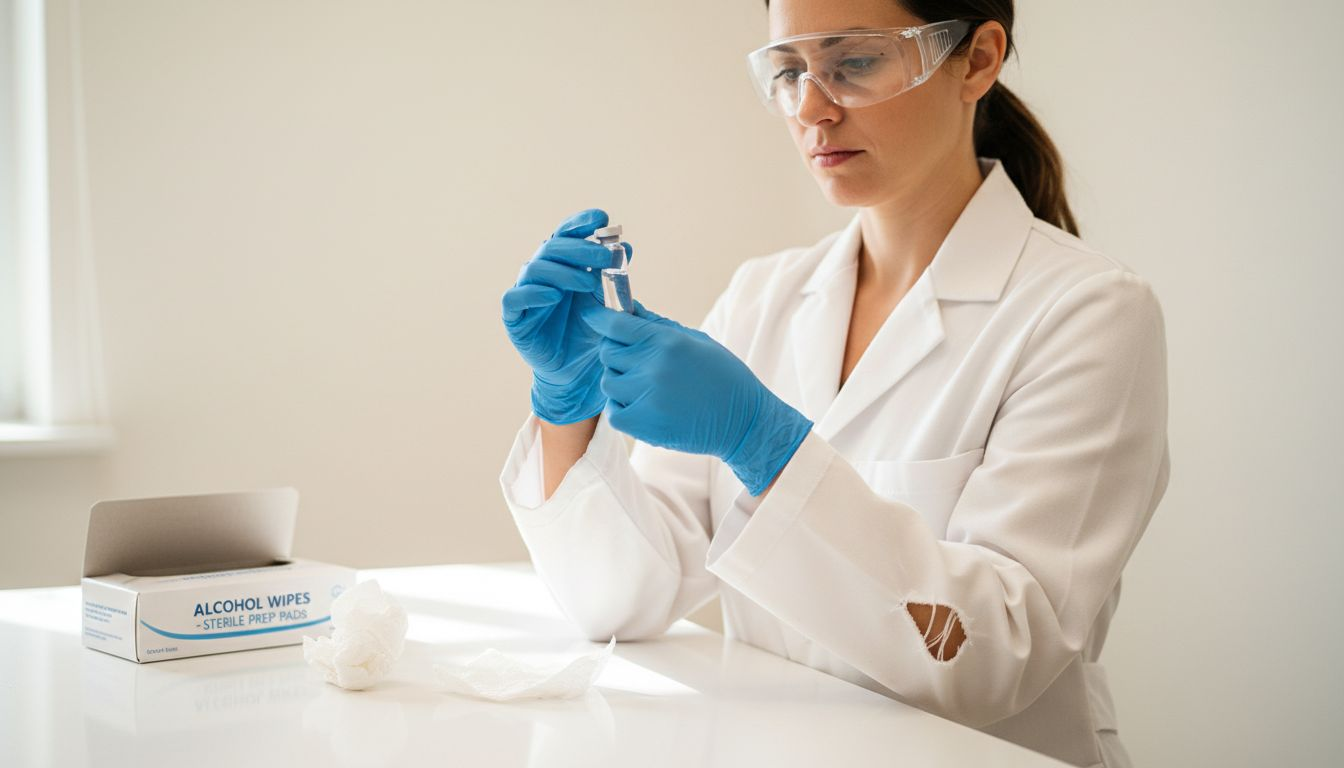
Pro tip: Create a dedicated sanitization kit with alcohol wipes, gloves, and disposable surfaces to streamline your workspace preparation process.
Step 3: Add solvent to peptide vial for dissolution
Adding solvent to your peptide vial is a delicate process that demands precision and care. Peptide dissolution requires a strategic approach to maintain molecular integrity and prevent potential structural damage during reconstitution.
The key to successful peptide reconstitution lies in precise solvent addition techniques. Your technique matters more than you might realize:
- Select the appropriate solvent (bacteriostatic water recommended)
- Use a sterile syringe with a fine gauge needle
- Aim the solvent against the vial wall
- Inject slowly and smoothly
- Avoid direct contact with lyophilized powder
Follow these critical steps for optimal dissolution:
- Draw solvent into the syringe carefully
- Approach the vial at a slight angle
- Gently inject solvent along the interior glass wall
- Allow liquid to trickle down slowly
- Minimize aggressive movement or direct powder contact
Gentle technique preserves peptide molecular structure and research integrity.
After adding the solvent, rotate the vial gently to encourage dissolution. Do not shake vigorously, as this can cause foaming and potentially damage the peptide’s delicate molecular configuration. Let the vial sit for a few moments, allowing the powder to fully integrate with the solvent.
Pro tip: Always calculate your desired concentration beforehand and use precise measurements to ensure consistent research outcomes.
Step 4: Mix peptides gently for perfect clarity
Achieving a crystal-clear peptide solution requires more than just adding solvent – it demands a delicate touch and precise technique. Peptide mixing is an art form that can make or break your research integrity.
The goal is to dissolve peptides without compromising molecular structure. Your mixing strategy matters immensely:
- Avoid aggressive shaking
- Use gentle circular motions
- Observe solution transparency
- Check for complete dissolution
- Inspect for particulate presence
Execute the mixing process with these strategic steps:
- Hold vial at a 45-degree angle
- Roll vial slowly between your fingers
- Allow gravity to assist dissolution
- Rotate vial in consistent, smooth circles
- Pause and inspect solution clarity
Patience transforms powder into precision research material.
Visual confirmation is critical. A properly dissolved peptide solution should appear completely transparent, with no visible particles or cloudiness. If you notice any residue or unclear areas, continue the gentle rolling process until the solution achieves uniform clarity.
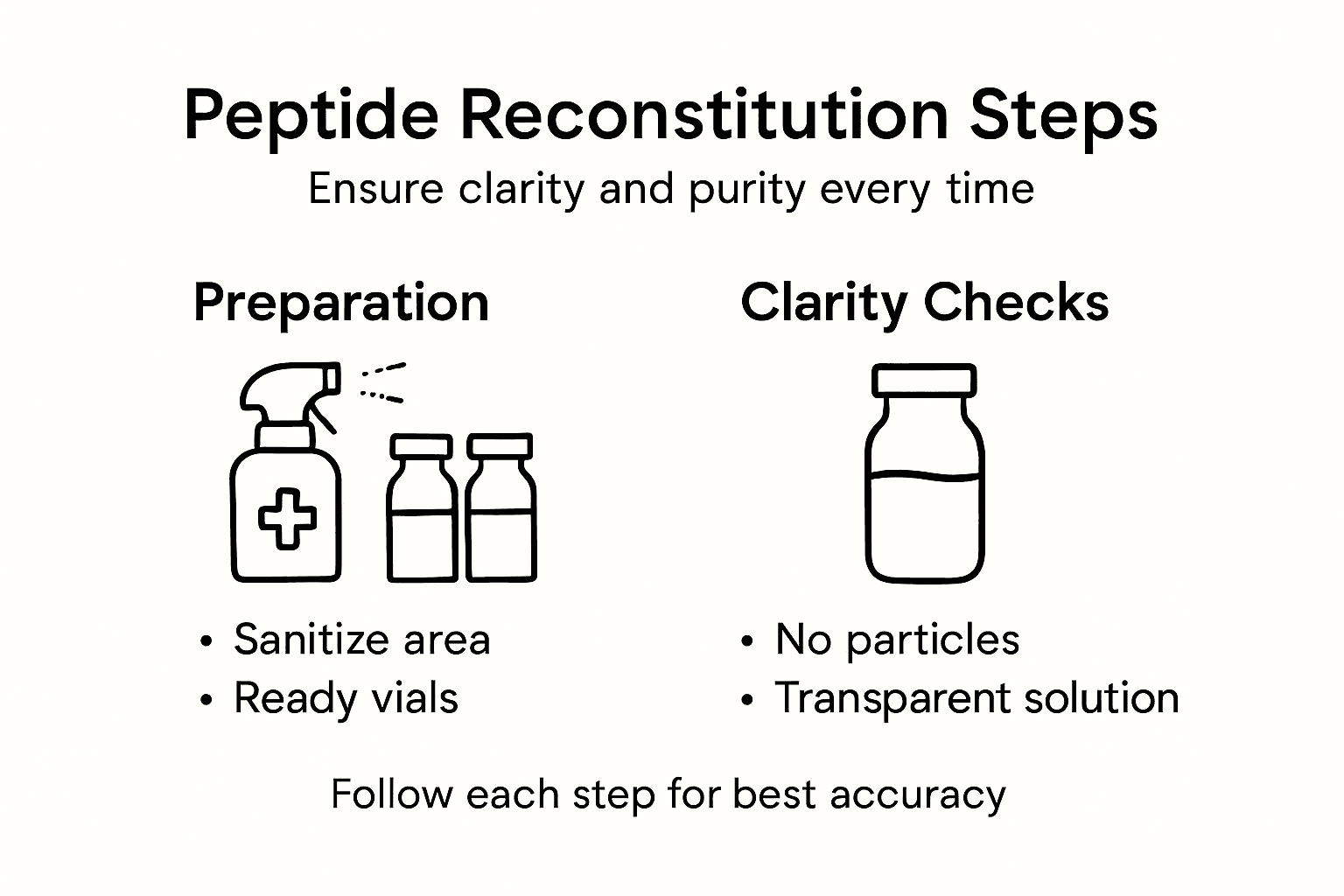
Pro tip: Always mix peptides at room temperature and never under direct light to maintain molecular stability.
Step 5: Verify purity and stability of reconstituted sample
The final stage of peptide reconstitution demands meticulous verification to ensure research-grade quality. Sample validation represents the critical checkpoint between preparation and experimental application.
Understand the sophisticated analytical techniques for peptide verification with these comprehensive assessment strategies:
- Inspect solution clarity and color
- Check for particulate matter
- Confirm complete dissolution
- Evaluate solution homogeneity
- Assess storage conditions
Perform these systematic verification steps:
- Visual inspection under good lighting
- Use magnification if necessary
- Confirm no color changes
- Check for consistent solution texture
- Record initial observation timestamps
Precision in observation prevents potential research complications.
Visual and physical characteristics serve as initial purity indicators. A high-quality peptide solution should appear crystal clear, with no cloudiness, precipitation, or unexpected color variations. Any deviation from expected appearance warrants immediate re-examination or potential sample replacement.
Pro tip: Document your verification observations meticulously, including time, temperature, and visual characteristics for future reference and reproducibility.
Use this summary to confirm your peptide solution’s quality before proceeding:
| Verification Check | What to Look For | Indicates Purity |
|---|---|---|
| Solution Appearance | Completely transparent | High |
| Color Consistency | No unexpected changes | Stable |
| Particulates Detected | None visible | Excellent |
| Homogeneity | Even, smooth texture | Reliable |
| Documentation Complete | Detailed records kept | Reproducible |
Elevate Your Peptide Research with Texas-Speed Purity and Swag
Mastering peptide reconstitution demands precision from gathering sterile materials to verifying solution clarity. The article breaks down every exacting step needed for reliable lab results. But even the sharpest technique hits a wall without the right compounds and supplies that match that level of rigor. That is where Area 15 Labs comes into play. We combine lightning-fast Texas shipping with high-purity peptides and bacteriostatic water to remove the guesswork from your research setup. Our gear supports your need for exact solvent measurements, sterile conditions, and verified peptide integrity.
Why settle for overseas delays or dry clinical brands when you can get trusted, ethically sourced research products that arrive same-day? Dive deeper into peptide handling fundamentals with our No-BS Knowledge Hub and explore next-gen stacks like Retatrutide that set new standards in reconstitution ease and stability. Don’t let shipping speed or supply doubts slow your discovery. Take control of your workflow and feel the confidence of partnering with the “No-BS” research command center right here in Texas.
Ready to bring swagger and scientific precision to your peptide prep? Discover your dependable source today at Area 15 Labs and gear up to research harder with us.
Frequently Asked Questions
What are the essential supplies needed for peptide reconstitution?
You will need lyophilized peptide vials, sterile water, precision insulin syringes, alcohol prep pads, sterile gloves, microcentrifuge tubes, and micropipettes. Gather all these items to ensure a smooth and accurate reconstitution process.
How should I sanitize my workspace before peptide handling?
Start by clearing all unnecessary items from your work surface and laying down disposable absorbent laboratory bench paper. Wipe down all surfaces with 70% isopropyl alcohol to create a clean, sterile environment.
What is the best technique for adding solvent to a peptide vial?
To add solvent, use a sterile syringe and aim for the vial wall to minimize contact with the lyophilized powder. Inject the solvent slowly to prevent bubbles or foaming, which can affect peptide integrity.
How can I mix peptides gently for optimal dissolution?
Hold the vial at a 45-degree angle and roll it slowly between your fingers in circular motions. Avoid shaking the vial aggressively; this technique ensures a smooth, clear solution without damaging the peptides.
What steps should I take to verify the purity of the reconstituted sample?
Inspect the solution for clarity, color consistency, and particulate matter. Document any changes or observations carefully to confirm the sample’s quality before proceeding with experiments.
Why is it important to maintain proper storage conditions for peptides?
Proper storage conditions are crucial to preserving peptide stability and integrity. Store reconstituted samples at the recommended temperature and avoid exposure to light to maintain their effectiveness for research purposes.