

Most American researchers are surprised to learn that advanced triple agonist peptides like Retatrutide have shown up to 24 percent weight reduction in recent trials. For Texas citizen scientists dedicated to exploring the newest metabolic research tools, staying ahead means navigating both innovation and strict regulations. This resource spotlights how informed sourcing, safety protocols, and peer-driven insights help you access and evaluate sophisticated compounds while upholding transparency and compliance.
Table of Contents
- Retatrutide’s Science: Triple Agonist Basics
- How Retatrutide Stacks Up In Research
- The Current Legal Status In The USA
- Navigating Online Sourcing And Safety
- Research-Only Rules: What You Must Know
Key Takeaways
| Point | Details |
|---|---|
| Retatrutide’s Mechanism | Retatrutide functions as a triple receptor agonist, targeting GLP-1, GIP, and glucagon receptors to enhance metabolic responses. |
| Clinical Research Potential | Early trials indicate Retatrutide offers up to 24% weight reduction and improved glucose control compared to other options. |
| Regulatory Status | Retatrutide is restricted to clinical research with no current FDA approval for commercial use, emphasizing regulatory compliance. |
| Research Integrity | Strict adherence to Research Use Only protocols is essential to maintain scientific standards and prevent misuse. |
Retatrutide’s Science: Triple Agonist Basics
Retatrutide represents a groundbreaking advancement in research peptides, functioning as a sophisticated triple receptor agonist that simultaneously targets glucagon, GIP, and GLP-1 receptors. Research from Nature demonstrates how this unique molecular design enables complex metabolic interactions by engaging multiple receptor pathways simultaneously.
The triple agonist mechanism differentiates Retatrutide from previous dual-receptor compounds through its nuanced approach to receptor engagement. By activating glucagon-like peptide-1 (GLP-1), glucose-dependent insulinotropic polypeptide (GIP), and glucagon receptors concurrently, the peptide generates synergistic metabolic responses that go beyond traditional single-pathway interventions. These interactions potentially enhance energy expenditure, regulate appetite, and improve glycemic control through intricate biochemical signaling.
Cryo-electron microscopy studies reveal fascinating insights into Retatrutide’s molecular interactions. Detailed scientific analysis from Science Direct indicates that the peptide’s structural configuration allows for differentiated potency across these receptors, enabling more sophisticated metabolic modulation compared to earlier generation compounds. The result is a research tool with remarkable potential for understanding complex physiological mechanisms related to energy metabolism and glucose homeostasis.
Key characteristics of Retatrutide’s triple agonist design include:
- Simultaneous activation of GLP-1R, GIPR, and GCGR receptors
- Enhanced metabolic pathway interactions
- Potential for advanced research in energy expenditure
- Sophisticated molecular engineering approach
Research Pro Tip: When investigating peptide interactions, always cross-reference multiple receptor engagement mechanisms to understand full metabolic potential.
How Retatrutide Stacks Up In Research
Retatrutide has emerged as a promising research compound, demonstrating remarkable potential in clinical investigations. Comprehensive research from MDPI reveals the peptide’s exceptional performance in preclinical and early-stage trials, showcasing significant advancements in metabolic research approaches.
In Phase 2 clinical evaluations, Retatrutide has distinguished itself through impressive outcomes. Peptide research data indicates the compound produces up to 24% weight reduction at 48 weeks, substantially outperforming existing pharmacotherapeutic options like tirzepatide and semaglutide. The compound’s unique triple receptor engagement mechanism enables simultaneous appetite reduction and energy expenditure enhancement, representing a sophisticated approach to metabolic research.
Research trials have highlighted several key performance attributes of Retatrutide:
- Consistent dose-dependent weight reduction
- Improved glucose metabolic control
- Reduced liver steatosis
- Preservation of lean muscle mass
- Comparable safety profile to established GLP-1 receptor agonists
The ongoing Phase 3 clinical investigations aim to further validate Retatrutide’s long-term efficacy and comprehensive metabolic potential across diverse research populations. Researchers continue to explore its nuanced interactions and comprehensive physiological impacts.
Here is a summary comparing Retatrutide with popular metabolic research peptides:
| Compound | Receptor Targets | Weight Reduction (48 weeks) | Muscle Preservation |
|---|---|---|---|
| Retatrutide | GLP-1, GIP, Glucagon | Up to 24% | Yes |
| Tirzepatide | GLP-1, GIP | Up to 21% | Partial |
| Semaglutide | GLP-1 | Up to 15% | Limited |
Research Pro Tip: Always cross-reference multiple clinical trial phases to develop a holistic understanding of a research compound’s comprehensive metabolic interactions.
The Current Legal Status In The USA
Current FDA regulatory tracking reveals that Retatrutide remains strictly confined to clinical research environments in the United States, with no current commercial approval for broader applications. The compound is navigating the complex regulatory landscape of pharmaceutical development, specifically positioned within late-stage Phase 3 clinical trials.

The legal framework surrounding Retatrutide is explicitly clear: any commercial marketing, distribution, or compounding outside approved research protocols is prohibited. Researchers and institutions must adhere to stringent FDA guidelines, ensuring that the compound remains exclusively within controlled scientific investigation contexts. This regulatory approach underscores the commitment to comprehensive safety evaluations and rigorous scientific validation before potential broader deployment.
Key legal considerations for Retatrutide in the USA include:
- Restricted to clinical trial environments
- Requires specialized institutional research approvals
- No current marketing authorization
- Potential FDA approval anticipated between late 2026 and early 2027
- Strict prohibition on unauthorized commercial distribution
Researchers and institutional stakeholders must maintain meticulous documentation and comply with all federal regulations governing investigational compounds. The ongoing clinical trials represent a critical phase in determining Retatrutide’s potential future regulatory status and broader scientific applications.
Research Pro Tip: Always verify current regulatory status directly with official FDA communications before initiating any research protocol involving investigational compounds.
Navigating Online Sourcing And Safety
Researchers investigating Retatrutide must exercise extreme caution when considering online sourcing strategies, prioritizing institutional integrity and compliance with rigorous scientific standards. Exploring legitimate research peptide platforms requires a comprehensive understanding of reputable supplier characteristics and critical verification protocols.
Critical considerations for responsible research compound acquisition include:
- Verifying comprehensive third-party laboratory certifications
- Confirming product purity documentation
- Validating domestic research supply chain transparency
- Ensuring institutional research compliance
- Maintaining meticulous documentation of acquisition processes
Navigating the complex landscape of research peptide procurement demands a strategic approach. Researchers should prioritize suppliers demonstrating robust quality control mechanisms, transparent sourcing practices, and comprehensive analytical documentation. The selection process must transcend superficial marketing claims, focusing instead on verifiable scientific credentials and institutional reputation.
Key red flags that signal potential unreliable research compound sources include inconsistent product documentation, limited transparency regarding manufacturing processes, absence of comprehensive analytical certificates, and marketing language that overpromises potential research outcomes. Institutional researchers must remain vigilant, treating compound selection as a critical component of scientific integrity.
The following table highlights research compound acquisition best practices versus common red flags:
| Acquisition Aspect | Best Practice Example | Red Flag Indicator |
|---|---|---|
| Supplier Verification | Third-party lab certifications provided | No certificates available |
| Documentation | Complete product purity reports included | Incomplete or missing records |
| Transparency | Clear U.S. supply chain documentation | Vague source information |
| Marketing Language | Factual, science-based descriptions | Overpromising research claims |
Research Pro Tip: Always request and independently verify multiple layers of scientific documentation before finalizing any research compound acquisition.
Research-Only Rules: What You Must Know
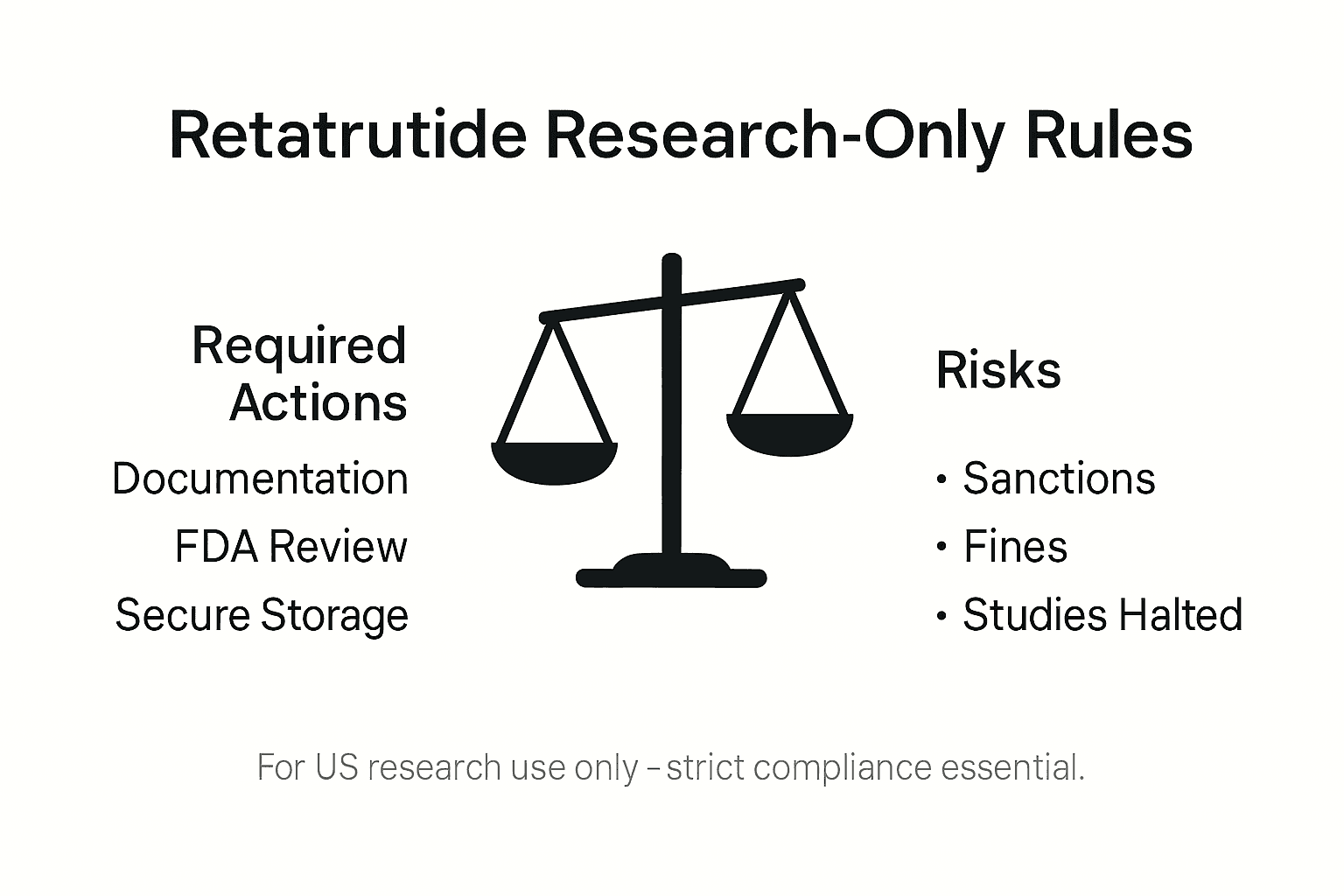
Research Use Only (RUO) protocols represent the critical framework governing scientific investigation of compounds like Retatrutide, establishing stringent guidelines that protect both research integrity and institutional standards. These comprehensive regulations mandate precise documentation, controlled handling, and explicit limitations on compound utilization within strictly defined scientific contexts.
Key principles of Research Use Only protocols include:
- Absolute prohibition on human consumption
- Requirement for institutional research approval
- Mandatory comprehensive documentation
- Strict chain of custody tracking
- Explicit laboratory safety protocols
- Comprehensive quality control measures
Researchers must understand that Research Use Only designation is not merely a technical classification but a fundamental ethical commitment. This framework ensures that investigational compounds remain within controlled scientific environments, preventing potential misuse and maintaining the highest standards of research methodology. Each research institution maintains its own specific interpretation of RUO guidelines, necessitating meticulous attention to institutional-specific requirements.
The consequences of violating Research Use Only protocols can be severe, potentially including institutional sanctions, research funding withdrawal, and professional reputation damage. Researchers must approach these guidelines with the utmost seriousness, treating each investigational compound as a critical scientific resource requiring exceptional professional responsibility and ethical consideration.
Research Pro Tip: Always document every interaction with research compounds, maintaining a comprehensive and transparent record of all research activities.
Discover the Future of Metabolic Research with Retatrutide and Area 15 Labs
The article highlights the complex scientific promise of Retatrutide as a triple receptor agonist targeting GLP-1, GIP, and glucagon receptors. Researchers face critical challenges such as ensuring compound purity, navigating strict legal frameworks, and sourcing from reputable suppliers while advancing metabolic studies. Retatrutide’s cutting-edge design demands a no-nonsense partner who understands these nuances and delivers fast, transparent, and reliable research-grade materials within stringent regulatory boundaries.
Area 15 Labs is that partner. Shipped fresh from Texas with same-day fulfillment, we combine lightning-fast delivery with verified third-party purity testing to give you uncompromising quality. Our approach matches the article’s emphasis on rigorous verification and legal compliance, offering a clear alternative to overseas or sketchy suppliers highlighted as major risks. Embrace the “no BS” ethos with a visually striking brand that speaks the language of modern researchers while delivering alien-level precision and reliability.
Ready to push the envelope on Retatrutide research with speed and swagger? Explore our collection of next-gen agonists and exclusive blends in the Alien Tech & Next-Gen Stacks lineup. Stay informed and ahead with our No-BS Knowledge Hub full of deep-dive educational content aligned with the latest research insights. Don’t settle for slow or shady options when you can research harder and faster with Area 15 Labs. Check out our offerings now and experience why we are the trusted Texas-based command center for citizen scientists everywhere.
Frequently Asked Questions
What is Retatrutide and how does it function?
Retatrutide is a triple receptor agonist that targets glucagon, GIP, and GLP-1 receptors, enabling complex metabolic interactions through simultaneous receptor activation, which can enhance energy expenditure and improve glycemic control.
What are the main benefits of Retatrutide in clinical research?
In clinical trials, Retatrutide has demonstrated significant weight reduction of up to 24% over 48 weeks, improved glucose metabolic control, and preservation of lean muscle mass, making it a promising candidate for metabolic research.
What is the current legal status of Retatrutide in the USA?
Retatrutide is currently restricted to clinical trial environments in the USA and has no commercial approval for broader applications. Any unauthorized distribution or use outside approved research protocols is prohibited.
What should researchers consider when acquiring Retatrutide for research purposes?
Researchers should prioritize suppliers with comprehensive third-party laboratory certifications, detailed product purity documentation, and maintain meticulous documentation of the acquisition process; they should also be cautious of sources with vague information or incomplete records.